Anaerobic Digesters And Renewable Energy
Anaerobic digestion is a process that has been making strides to prove itself as the new big form of sustainable energy. Many smaller operations have established on-site digester tanks, such as dairy farms and other smaller locations, while communities in states such as Vermont and California have begun scaling to create self-sustaining energy production systems using anaerobic digestion.
The potential of anaerobic digestion has only grown as more people are becoming aware of its many benefits. In light of these developments and the continuing desire for renewable energy, more and more people are developing an interest in the capabilities of this process.
The Anaerobic Digestion Process
The anaerobic digestion process is actually quite simple. First, the digestion tank is filled with manure, wastewater, food waste or other organic matter, or a combination of these. These waste products are often gathered from everyday use or donated from additional local sources, as is the case in Salsbury, Vermont.
After elements are gathered in the tank, they are deprived of oxygen, allowing a complex of microbial organisms to break down the materials into two types of outputs — biogas and digestate. Biogas is used for a number of purposes, most notably serving as a clean alternative to natural gas, a common fossil fuel. The digestate is all the solid and liquid residual material left over. This product has many agricultural uses, such as bedding for animals, organic fertilizers, horticulture products, irrigation systems and more.
To learn more about this process, check out our complete guide to anaerobic digestion.
What Are Anaerobic Digesters?
Like the process of anaerobic digestion, the digesters are actually quite simple as well. These systems comprise sealed tanks, microbes and waste — the microbes remain inside the sealed tank and break down the waste as it is added.
Although all anaerobic digesters are designed to complete the same task, they are not all the same. The inputs and processes vary depending on the type of digester, but all will produce biogas as intended. Some defining characteristics of different digesters include operating temperature, feedstock variation (inputs), batch or continuous flow (loading process), or wet or dry (inputs).
In terms of temperature, the most common type of anaerobic digester is classified as mesophilic. Mesophilic digester tanks operate between 77 and 113 degrees Fahrenheit. Thermophilic anaerobic digesters operate faster and at higher temperatures, but they come at a higher cost.
If you’d like to learn more about these systems, we have a detailed breakdown of the various types of anaerobic digesters.
Why Anaerobic Digestion Is the Next Big Renewable Energy Source
With the worldwide push to transition away from fossil fuels and other nonrenewable energy sources, new technology is constantly emerging, and anaerobic digestion is no stranger to the conversation. In fact, anaerobic digestion is rising in popularity, and for good reason.
Refined Output Potential
With the help of the U.S. Department of Energy, it is quite feasible for the outputs of anaerobic digestion to be refined with specific timing to create valuable resources. If the process is timed to be ended after the breakdown into alcohol, but before the transition into methane and carbon dioxide, the outputs can be refined into jet fuel, gasoline and other high-value products.
Since the carbon released during this process was already absorbed from the atmosphere from the plants (that become the food, then the waste, then the gas) this process would be considered renewable.
Lower Process Time

In conjunction with the carbon emissions being renewable energy, the processing time for waste to be processed into biogas via anaerobic digestion is quite fast. For example, an anaerobic digester operating at 98 degrees Fahrenheit, treating cow manure, will take 30 days to produce biogas. Compare this to the millions of years it takes to produce fossil fuels.
Input Availability
In comparison to other renewable energy sources that may be faster in output, anaerobic digestion has the potential to be a continuous process, as its required inputs are not dependent on natural elements such as wind, tides and the sun. While all of these are sufficient in supply, they are often inconsistent in their delivery and require select circumstances to be effective.
On the contrary, anaerobic digestion relies on natural waste, which can be provided by common everyday functions of human life and agricultural processes. For example, food waste and wastewater biosolids can be collected from any community, rural or urban, while approximately 44% of the United States is dedicated to farmland, all of which can contribute organic materials and manure for anaerobic digestion.
Creating a Self-Sustaining Community
With the ability to use such commonly accessible resources for the production of biogas, there is a potential for communities to use anaerobic digestion systems to create a closed-loop system of self-sustaining energy producers. In fact, it’s already been done.
In Northern California, the East Bay Municipal Utility District now produces 135% of the community’s energy needs with the help of 11 digestion units and three turbines. This success comes from setting up food waste collection stations and on-site digesters for dairy farms. Other communities are adopting plans to collect their materials based on the output of their local agricultural operations. Some digesters then return their solid outputs such as fertilizer back to the local farms that donated the initial input material.
Processes like this allow communities to gather inputs completely customized to their local consumption habits while gaining the ability to pay it forward by providing energy and resource outputs that exceed their needs. Communities like EBMUD that produce beyond 100% of their energy needs then have the potential to sell that energy to other communities, setting themselves up for local economic development.
Clean and Maintain Your Digester Tanks With Bristola
Although the digester tanks are designed to be sealed, the insides should still be cleaned every few years to ensure optimal efficiency and longevity. Most methods of industrial tank cleaning are costly and challenging, as they require the tank to be emptied. That’s why the proprietary Submersible Robotic Cleaning Systems from Bristola are ideal for cleaning your anaerobic digesters. Bristola offers over 20 years of experience providing anaerobic digester cleaning services with minimal impact to a system’s productivity.
Our service can clean single tank operations or even entire systems without shutting down facilities. This zero-human entry system utilizes remotely operated vehicles to enter covered lagoons and tanks without removing the cover while collecting and storing vital system information for future and ongoing maintenance.
The system requires installation of an entry portal that can be adapted to any manhole 24 inches or larger. The portal allows for easy repeated entry and ongoing maintenance tasks without needing tanks to be repeatedly drained and refilled for every procedure.
Contact Bristola today for more information on our anaerobic digester cleaning services or to schedule a demonstration.

The post Anaerobic Digesters And Renewable Energy appeared first on Bristola.
]]>What Is Anaerobic Digestion?
Anaerobic digestion (AD) is a microbiological process that uses anaerobic conditions to convert organic waste into biogas and digestate. Without oxygen, it’s a sequence of processes involving microorganisms that break down plant and animal matter. The anaerobic digestion process happens in an anaerobic digester — a sealed, oxygen-free tank. Organic materials such as slurries, food waste and crop residues convert into biogas, a methane-rich gas used as a digestate, renewable fuel, fertilizer and more.
Anaerobic digestion is a cost-effective, environmentally friendly solution for dealing with waste. Instead of sending it to a landfill — which can damage wildlife habitats and lead to dangerous methane emissions — or burning it — which subjects individuals and companies to strict regulations and burn standards — anaerobic digester cleaning plants turn waste into something potentially useful.
Let’s take a deeper look into how the anaerobic digestion process works, what the benefits are, how often a digester tank should be cleaned and more.
How Does The Anaerobic Digestion Process Work?
Anaerobic digestion is the process of anaerobic digestion in the digester. It’s the natural biological decomposition of organic materials — plants and animals — by microorganisms devoid of oxygen.
Anaerobic digestion for the purpose of biogas creation happens in a sealed tank known as a reactor. In these reactors, the waste material is digested by a complex of microbial organisms, producing biogas. It is then expelled from the digester. You can combine several organic materials in a digester in a process known as co-digestion.
Take a look at the following materials that can process in a digester:
- Industrial organic residuals
- Wastewater biosolids
- Food scraps
- Animal manures
- Municipal wastewater solids
- Fats, oils and grease (FOG)
Benefits of Anaerobic Digestion
Anaerobic digestion is deemed more sustainable than composing digestion. These digesters provide an array of benefits compared to traditional systems, including:
- Sustainable production: Anaerobic digestion allows for sustainable food production, energy production and can even produce more sustainable fertilizers.
- Waste removal or conversion: This process converts waste into green energy. It can also be purified to become biomethane.
- Improved processes: The anaerobic digestion process reduces odor below unprocessed levels compared to other methods.

What Is Made During the Anaerobic Digester Process?
Anaerobic digestors produce either biogas or digestate. Natural bacteria that dwell within oxygen-free anaerobic digesters kickstart the process. These organisms break down organic substances as they develop. Biogas is produced as organic matter decomposes.
Biogas
Biogas is a renewable fuel that is composed of mostly methane, carbon dioxide, hydrogen sulfide, water vapor and other substances. Carbon dioxide and other gases can be eliminated during this process, leaving only methane, which is the essential component of natural gas.
The energy produced in biogas can help organizations:
- Generate or deliver heat and electricity.
- Produce mechanical power.
- Supply businesses and homes.
- Run vehicles with alternative fuel.
- Use renewable natural gas.
- Provide power cooling systems.
Digestate
The excess substance left over from the digestive process is known as digestate. The nutrient-rich, wet substance is separated into solid and liquid parts and can be utilized for a variety of purposes, including:
- Creating sustainable nutrient-rich, organic fertilizer.
- Animal bedding.
- Crop irrigation for small and industrial farms.
- Creating organic compost.
Anaerobic Digester Cleaning Designs
Once the organic materials are prepared and ready, it’s then added to the anaerobic digester. Given the collection system type, the digester provides ideal conditions for converting waste into biogas. There are many different types of anaerobic digesters available.
For organic waste like manure and industrial wastewater treatment, anaerobic system designs include:
- Covered lagoon digester: A covered lagoon design includes a flexible cover and a sealed top where methane is collected and supplied to the combustion device. For integrated digestion and storage, some designs use a single cell.
- Plug flow digester: This type of digester uses a narrow concrete tank with a flexible or firm cover. It’s primarily used at dairy farms and collects manure by scraping.
- Complete mix digester: This digester is designed with a heated tank enclosed with a mechanical, hydraulic or gas mixing system. These complete mix digesters perform optimally when the excreted manure is diluted with water.
- Dry digester: The dry digester is a silo-style digester made of concrete and steel with a firm cover. These operate with dilute liquid matter or co-substrates and dry matter, like manure and crop residuals.
Bristol’s Anaerobic Digester Cleaning Solution With Zero-Human Entry
Cleaning your covered lagoon or tank on a regular basis is critical to its structural integrity. Traditional digester tank cleaning methods can often be challenging and expensive. That’s why Bristola’s proprietary Submersive Robotic Cleaning Systems solves these timely issues by using a submersible, remotely operated vehicle (ROV) to reach the sediment.
The system is an anaerobic digester tank cleaning service system that cleans and maintains your tank, covered lagoon and similar, ensuring it remains in good condition. It’s a zero-human entry system that allows our remotely operated vehicles to enter your covered lagoon or tank without removing the cover of the lagoon or lid of the tank. The system also stores data and reports information about your tank’s condition.
Our ROV is attached to a hoist system and goes in from the roof of your tank or at the top of your lagoons cover to the floor at various heights. With our advanced systems in place, you can save money, enjoy more convenient processes and implement improved safety measures for employees.
A digester tank should be cleaned at least once every several years and as needed to ensure it’s running at its optimum efficiency.
Get Your Anaerobic Digester Cleaned with Bristola
Anaerobic digester cleaning is imperative, regardless of the type of digester used. Our zero-human entry cleaning system keeps your liquid storage facility working to its full potential — all while saving you time and money on maintenance and cleaning.
Bristola also offers a unique entry portal that can be placed on the manhole of tanks to allow us to easily re-enter and service your tank in the future.
As an industry-leading company with over 20 years of experience in the field, you’ll be provided with industry experts in anaerobic digester cleaning. Contact Bristola to learn more about our Submersive Robotic Cleaning System or request a demo today.

The post What Is Anaerobic Digestion? appeared first on Bristola.
]]> Types of Anaerobic Digesters
All anaerobic digesters are designed to perform the same basic task — break down organic matter through anaerobic digestion to produce biogas, a mixture of gases created when waste decomposes, which serves as a renewable energy source. However, different types of digesters achieve that objective in different ways. Ultimately, digesters can feature subtle differences in construction and material handling techniques that affect the way they function.
The sections below will go over the distinguishing characteristics of anaerobic digesters, some specific types of anaerobic digesters and their common uses. Keep reading to learn more about the kinds of anaerobic digesters available and how to maintain them for optimal performance.
Common Differences Among Anaerobic Digesters
These systems are constructed for numerous reasons and are distinct in many different ways. This section describes some of the main differences among types of anaerobic digesters. The main differences include temperature, feedstock variation, flow and moisture content.
Operating Temperature
An anaerobic digester is built to run at particular target temperature ranges because different types of anaerobic microbes thrive in different temperature zones. Typically, the temperature range for mesophilic anaerobic digestion is between 86 and 100 degrees Fahrenheit, while the range for thermophilic anaerobic digestion is between 122 and 140 degrees Fahrenheit.
Usually, thermophilic anaerobic digestion is necessary for greater pathogen kill. The higher temperature range produces Class A Biosolids, which can be legally used as fertilizer on farms or commercial vegetable gardens and sold for use as compost or fertilizer for home gardens. While thermophilic digesters take less time to process feedstocks, they often come with higher costs and may be challenging to operate.
On the other hand, mesophilic anaerobic digesters are generally easier to operate and maintain. However, a mesophilic digester does not produce sufficient pathogen kill to generate Class A Biosolids.
Feedstock Variation
Different anaerobic digesters are designed to process various types of feedstock. Some digesters are even designed to process multiple feedstocks, which is known as co-digestion. Some feedstocks may also need or benefit from pre-processing measures before digestion, such as screening, blending or thermal conditioning.
Batch or Continuous Flow
For batch digesters, every feedstock is loaded at one time. After loading, digestion occurs within a set period of time before the digester gets emptied and reloaded manually. For a continuous flow digester, the feedstocks are constantly fed into the digester, and the digested material gets continuously removed after digestion.
Wet or Dry
The feedstocks’ moisture content classifies it as wet or dry. Known as a low solids anaerobic digestion system, wet digesters are more common than dry and usually process feedstock with less than 15% solids content. These types of feedstocks are most often in slurry form and able to be pumped.
A dry digester, also referred to as a high solids anaerobic digestion system, typically processes feedstock with a solids content higher than 15%. These kinds of feedstocks are commonly described as stackable.
What Types of Anaerobic Digesters Exist?
Now that you know how anaerobic digesters can vary, it’s time to discuss the specific types of anaerobic digesters available. In general, there are three main types of anaerobic digesters — passive systems, low rate systems and high rate systems. Within these broad categories, you’ll find different types of anaerobic digesters useful for different purposes.
Below, you’ll learn more about the variations of passive systems, low rate systems and high rate systems.
1. Passive Systems
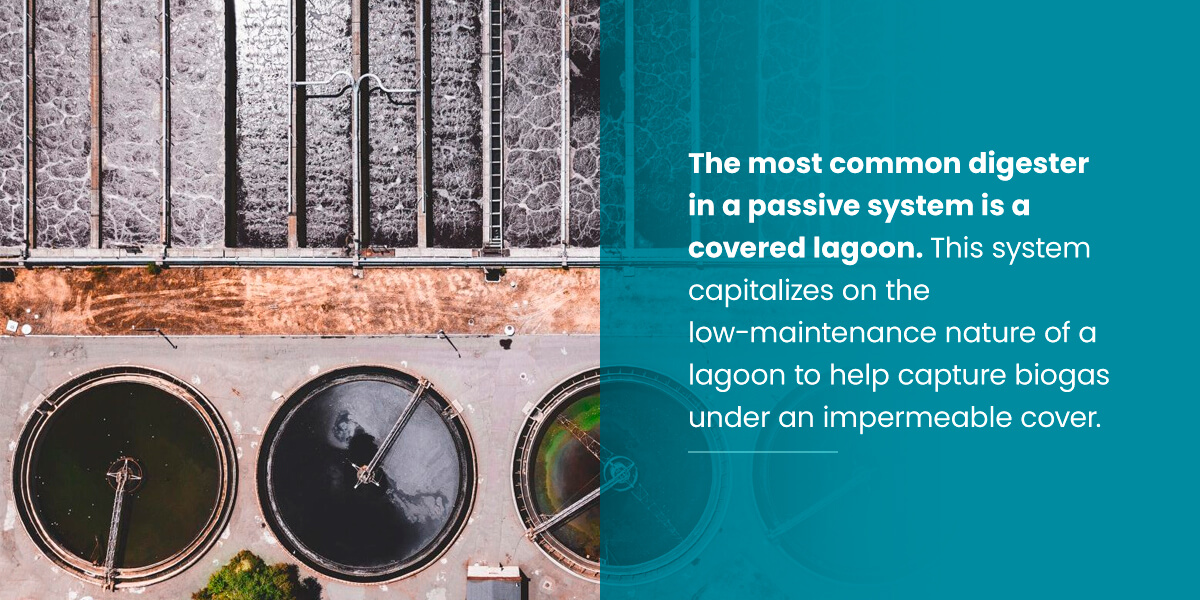
These systems refer to when biogas recovery is added to an existing treatment component. The most common digester in a passive system is a covered lagoon. This system capitalizes on the low-maintenance nature of a lagoon to help capture biogas under an impermeable cover. Most covered lagoons follow a two-cell system, enabling the lagoon to serve as a storage space and a treatment system.
In a two-cell covered lagoon, the first cell is covered, while the second cell is left uncovered. The level of liquid in the first cell remains steady to promote manure breakdown and the liquid level in the second cell fluctuates to create storage. Because covered lagoons are not heated, temperatures follow seasonal patterns.
It’s possible to store sludge in covered lagoons for up to 20 years, meaning methane-forming microorganisms can also stay in covered lagoons for up to 20 years. In addition, much of the fertilizer nutrients, such as phosphorus, can also get trapped in a covered lagoon for decades. This tendency to retain substances makes regular cleanings critical for covered lagoons.
Only professionals can perform a covered lagoon cleaning. Ideally, anaerobic digester cleaning services can clean the storage portion of the covered lagoon without removing its contents, halting production or endangering anyone’s safety. Bristola has developed an innovative solution by using sonar robotic vacuums to clean the covered lagoon without shutting down the system.

2. Low Rate Systems
An anaerobic digester qualifies as part of a low rate system when the manure flowing through the digester serves as the main source of methane-forming microorganisms. These low rate systems can feature different types of anaerobic digesters, which are discussed in greater detail below.
Complete Mix Digesters
Essentially, a complete mix digester is a tank that heats manure and mixes it with an active mass of microorganisms. Any incoming liquid displaces the digester’s current volume, allowing an equal amount of liquid to flow out of the digester. Along with the displaced liquid, methane-forming microorganisms flow out of the digester.
Here, liquids remain in the complete mix digester for about 20-30 days, which maintains biogas production effectively. However, retention times may be shorter for thermophilic systems. Throughout the retention period, the digester can be either continuously or intermittently mixed, meaning the tank gets stirred during feeding and occasionally in between feeding times.
In some cases, the process occurs in more than one tank. For example, acid formers sometimes break down manure in one tank, followed by methane formers converting organic acids to biogas in another tank. Generally, complete mix digesters operate best when manure contains 3-6% solids. As lower solids levels correlate with greater volume, a larger digester must retain the microbes longer.
Plug Flow Digesters
The concept of a plug flow digester is similar to a complete mix digester in that manure flows into the digester and displaces the digester volume, causing an equal amount of material to flow out of the digester. However, the manure within a plug flow digester includes contents thick enough to prevent particles from settling at the bottom.
Minimal mixing occurs with a plug flow digester, making the manure move through the digester as a plug. These digesters are best for manure with solids as high as 20%, meaning extra material may need to be added to manure designated for a plug flow digester. An increase in biodegradable material results in more biogas.
The recommended retention time for plug flow digesters is about 15-20 days. Like all anaerobic digesters, plug flow digesters should also be cleaned routinely to keep sediment from building up and interfering with the quality of the liquids. Bristola’s liquid tank cleaning services provide a feasible way for organizations to have their digesters cleaned without halting operations.

3. High Rate Systems
Alternatively, high rate systems confine methane-forming microorganisms within the anaerobic digester to boost efficiency. More specifically, the following anaerobic digesters are commonly associated with high rate systems.
Anaerobic Contact Digesters
Known as contact stabilization digesters, anaerobic contact digester systems have to do with solids recycling. The digestion time can be decreased by returning some of the active organisms to the anaerobic digester. A plug flow system can achieve that advantage by pumping some of the effluent toward the front of the digester. On the other hand, complete mix digesters involve solids settling in an external clarifier before the microbe-rich slurry gets recycled back into the digester.
Fixed Film Digesters
At its most basic, a fixed film digester is a column filled with media, such as small rings of plastic or wood chips, that methane-forming microorganisms grow on. In this case, manure liquids pass through this media, coating the media in a slimy growth known as biofilm. This type of digester is also called an anaerobic filter or attached growth digester.
The retention time for fixed film digesters is relatively short — sometimes less than five days. However, manure solids can occasionally plug the media, requiring professional attention before returning to its usual processing. For this reason, this type of system needs regular anaerobic digester cleaning to remain efficient and effective.
Suspended Media Digesters
This type of digester involves suspending microbes in a continuous upward flow of liquid. The flow can be modified to let smaller particles wash out while keeping larger particles within the digester. Then, microorganisms create biofilms around the large particles and methane formers remain in the digester.
Certain suspended media digester designs include an artificial media like sand for microbes to produce more biofilm. These are referred to as fluidized bed digesters. Along with incorporating fluidized bed digesters, effluent is sometimes recycled as a way to maintain a steady upward flow.Sequencing Batch Reactor Digester.
Sequencing Batch Reactor Digester
This type of anaerobic digester is a specific version of an intermittently mixed digester that’s well-suited for extremely dilute manures. In an anaerobic sequencing batch reactor (ASBR) digester, methane-forming microorganisms get stored via settling solids and decanting liquid. This process includes four phases.
During the fill stage, the ASBR digester is fed. If filled with enough active microbes, an ASBR digester may produce biogas with completely soluble organic liquids. Next, the microbes and manure get mixed together in the react phase. This phase is quickly followed by the settle stage, which involves the solids being settled. Finally, effluent is drawn off during the decant stage. The ASBR digester may repeat the cycle up to four times per day, resulting in almost constant gas production.
The liquid retention time for an ASBR digester may be as short as five days. This quick turnaround calls for frequent liquid tank cleaning to remove sludge and enable the ASBR digester to operate at its full capacity. The zero-human entry Submersive Robotic Cleaning System from Bristola cleans the liquid storage facility without interfering with the digester’s everyday production.
How Different Types of Anaerobic Digesters Are Used
The following sections discuss anaerobic digesters commonly used for farms, water resource recovery facilities and manufacturing plants.
Anaerobic Digesters on Farms
An on-farm digester can add considerable value to farms and their surrounding communities. These digesters can aid farmers in managing nutrients, reducing odors and generating extra revenue. Most often, dairy, poultry and swine farms include an anaerobic digester of some sort. In addition to animal waste, on-farm digesters can accept outside food waste as feedstock.
The most common on-farm digesters include:
- Covered lagoons
- Plug flow
- Complete mix
The type of anaerobic digester found on a farm is usually determined by the farm’s manure management practices and the kind of animal waste available to feed into the digester. Typically, the biogas produced from the anaerobic digester systems is used for generating electricity, providing combined heat and power or fueling furnaces or boilers.
Anaerobic Digesters at Water Resource Recovery Facilities
A water resource recovery facility serves to produce clean water, recover nutrients and reduce the community’s dependence on fossil fuel by generating renewable energy. These facilities rely on anaerobic digesters to assist in their operations. Primarily, digesters treat wastewater solids, making them subject to EPA biosolids regulations.
To comply with regulations and fit with the facility, digesters at water resource recovery facilities can vary in the following ways:
- Size
- Shape
- Processing rate
- Number of stages to the process
- Operating temperature
- Extent of pre-digestion processing
- Types of mixing strategies
Depending on a specific water resource recovery facility’s needs, it could require any type of anaerobic digester. Currently, more than 1,200 water resource recovery facilities in the country use anaerobic digesters to produce biogas by treating wastewater solids. Many of them use the biogas as an energy resource for generating electricity or heat, which can be used for operations at the facility, sold to the grid or injected into natural gas pipelines.
Anaerobic Digesters at Manufacturing Plants
Known as stand-alone digesters, anaerobic digesters made for manufacturing plants or processing plants accept feedstocks from one or more sources for a tipping fee. These types of digesters can process industry-specific wastes, manage residential food waste or operate as community-based operations or organics recycling businesses.
Frequently, stand-alone digesters process food waste as their feedstock. However, some stand-alone digesters are designed to co-digest other organic materials like manure, yard waste and wastewater solids. Many anaerobic stand-alone anaerobic digesters are high rate systems to assist with co-digestion and increase methane production from difficult-to-digest or low-yielding materials.
Keep Anaerobic Digesters Clean With Bristola
Any type of operation with an anaerobic digester needs to have its digester cleaned routinely. Regardless of what type of anaerobic digester is on the grounds, regular anaerobic digester cleaning is imperative. Bristola offers professional digester cleaning services to ensure digesters are clean, well-maintained and able to perform at their full capacity.
Bristola services anaerobic digesters with a cutting-edge, zero-human entry Submersive Robotic Cleaning System that uses sonar robotic vacuums to clean tanks without removing their contents, halting production or risking human life. Bristola’s unique manhole cover technique replaces the tank’s existing cover to allow the robotic vacuums to enter without removing the cover.
Choosing the Bristola Submersive Robotic Cleaning System enables you to clean your anaerobic digester without shutting down your facility. In this way, our services are hassle-free and cost-effective. Additionally, our full-service system will collect data about your tank to evaluate its condition and performance.
We also offer a unique entry portal that is placed on the manhole of tanks. This valve will allow us to easily re-enter and service your tank in the future.
Contact Bristola today to learn more about our Submersive Robotic Cleaning System or schedule a demo.
The post Types Of Anaerobic Digesters appeared first on Bristola.
]]>How Often Should a Digester Tank Be Cleaned?
You should have your digester tank cleaned at least once every several years. At Bristola, we provide digester tank cleaning services that keep your tank running at peak efficiency while saving you time and money during the process.
A digester is a tank used for the biological treatment of organic matter. It helps control operational and environmental variables to speed up the treatment process.
Within a closed, oxygen-free digester, organic matter such as food waste and cow manure is broken down by microorganisms through anaerobic digestion. The broken-down organic materials create biogas, a renewable fuel that can be used for heating and electricity.
Routine cleaning is essential to your digester’s health. Over time, debris, grit and solids can build up at the bottom of your digester. A scum blanket can also develop at the digester’s top. The buildup at the bottom of the tank and the scum blanket on top reduce the digester’s effectiveness, preventing proper digestion.
Anaerobic Digester Tank Cleaning
Cleaning a digester tank can be a challenging task. Traditional cleaning methods may require halting production and emptying your digester, resulting in downtime and temporary storage expenses.
Once the digester is empty, workers must manually clean it. Typically, manual cleaning involves confined space entry in a harsh environment. Manual entry puts workers’ safety at risk, increasing their chance of injury and exposure to hazardous materials.
Benefits of Our Digester Tank Cleaning Services
At Bristola, we’ve solved the logistical, financial and safety problems of traditional digester cleaning. Our submersible robotic cleaning system replaces the manhole cover on your digester, allowing our remotely operated vehicles (ROVs) to enter through a new maintenance hole. Your digester can remain full while our ROVs clean, and no one has to enter the digester during the process.
We also offer a unique entry portal that is placed on the manhole of tanks that will allow us to easily re-enter and service your tank.
With our system in place, you can save time and money on digester cleaning while keeping your employees safe. Your digester will operate at a superior level with a more secure and efficient cleaning method.
Contact Bristola for Anaerobic Digester Tank Cleaning
If it’s been a few years since your digester was cleaned, Bristola can help. We are experts at anaerobic digester cleaning, with over 20 years of field service in the industry.
Want to see how our digester tank cleaners work? Get in touch today to schedule a demo and learn more about our services.
The post How Often Should a Digester Tank Be Cleaned? appeared first on Bristola.
]]>